
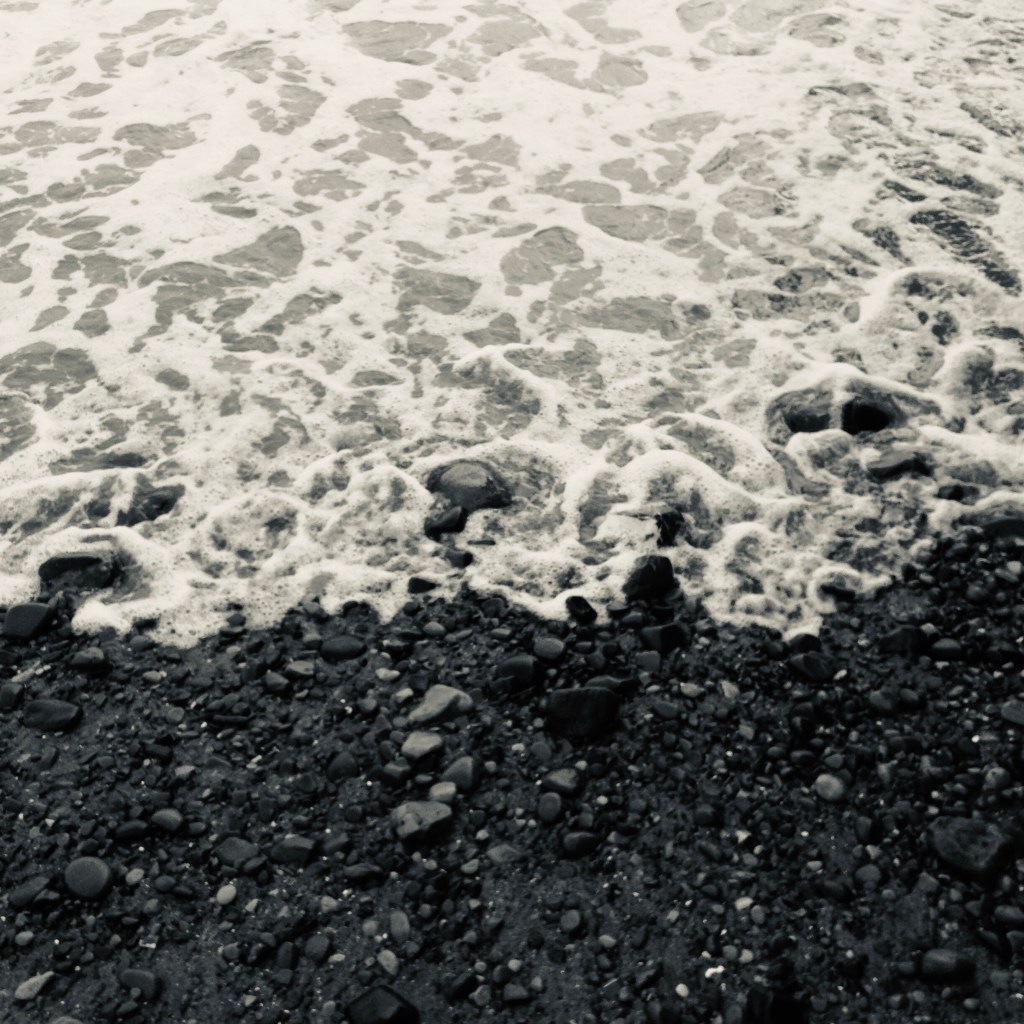
The empty beaches of lockdown make that pull to the water’s edge stronger. When I go to my beach I’m sucked towards the overlapping slap and fizz of lazy waves or the foaming crash of a spring tide. Have you felt it too, have you played ‘can’t catch me’ with the waves as you skirt their edges, unable to walk in a straight line? Have you taken the gifts left there at the water’s edge? Wet stones, feathers or wound pink shells? Have you given your own gifts in return – secrets, wishes or tears?
The water’s edge is a place of constant exchange. The sea delivers things to the shore – driftwood, ideas, invaders, saints and they change the land they arrive in. The North has been shaped into something rich and strange by those sea-changes.
‘nothing of him that doth fade
But doth suffer a sea-change
Into something rich and strange’
Shakespeare, The Tempest
The North is a place of arrival and change – those arrivals include:
An Irish-born monk called Aidan, washed up from the holy isle of Iona on the shores of Northumbria.
Aidan was followed by Cuthbert, who infused the land with his memory, protected his Cuddy Ducks (eiders), lives on in the feather star fossils known as Cuddy’s beads and he still intervenes in times of hopelessness for the North.
In 793 terrible portents appeared over Northumbria, flashes of lightning, fiery dragons seen flying through the air. It was the Vikings, who were seduced by the land and settled sharing their language, stories and crafts and leaving the ghost of their longships behind in the North mad cobles.
Jump forward to the industrial revolution and between 1880 and 1920 and the sea brought workers from Ireland and Scotland searching for new opportunities in the iron, steel, shipbuilding, mining and chemical industries.
Now the sea still brings people from across the world, looking for work, education, hope – they come from loving homes, streets they don’t want to forget or places that war has savaged. Like all those other arrivals on the shore, they come with new ways and ideas – food, festivals and stories to exchange.
Even when the arrivals are storms, like the beast from the East, the water’s edge reveals new changes. A 6000 year-old petrified forest sleeps beneath the sands at Redcar. The secret the sand hides is this – that Britain was not an island, that ten thousand years ago it was connected to Europe by Doggerland, a place of woods and valleys, birds and animals and people who could walk from Redcar to Denmark without dragon ships.
It is dangerous to see the sea as a border. It is just like Michael Rosen’s wonderful story ‘We’re Going on a Bear Hunt’ we can’t go over it, we can’t go under it, we have to go through it. It is not a boundary that divides us but an invitation to adventure so that we might discover who we were, who we are, who we might become.
Whatever the sea takes it is turned by the water, it loses its certainty of what it is, it’s the same with humans. I think that’s why we’re drawn to the edge of water. I suspect that we don’t want to be land-locked into one fixed identity but instead we want to be held as we change. If you’ve ever crossed the sea to make a new home somewhere else, you’ll know this deeply.
What would happen if we didn’t see ourselves as creatures bound to land? What would happen if we saw ourselves as always at the water’s edge – exchanging what we have with what already exists there?
I want to take you on a sea journey. We’re going to look at the water’s edge as a place between land and sea as a place where two worlds are in constant exchange and how we lose and find ourselves there.
Task – Sea Change
For anyone who has left home, to start a new job, go to university or start a new life.
• What did you take with you from your old home? It can be an object?
• What did you leave behind?
• What was the first thing you noticed about the new place? It could be something you saw or a strange habit of the people you noticed?
• What did you share from your old home? New words, food, stories?
• What do you still struggle to understand?
• How have you changed in the new place?
• What have you changed in the new place?
• If you could sum up the North in one word what would it be (it can be in a different language but please provide a translation).
Please email your responses by 1st June 2020 to carmenellen@hotmail.co.uk
I hope to be able to use your responses to help me get a better understanding of how people change and are changed by place in a project I’m undertaking to imagine a world beyond borders.
 Carmen Marcus
Leave a comment